Ethiopia emerges as a vibrant tapestry of artistic expression, where the essence of its landscapes and people is distilled into powerful visual narratives. Robel Wolde’s The Journey for Water stands as a luminous testament to this heritage, inviting the world to recognize the profound beauty and resilience embedded in Ethiopian art. This masterpiece transcends mere depiction, offering a window into a cultural legacy that harmonizes ancient traditions with a contemporary voice.
Ethiopia: A Rich Artistic Legacy
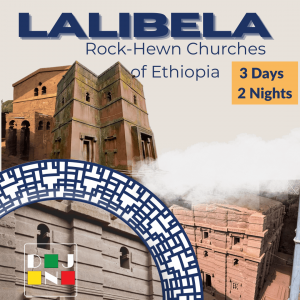
Ethiopia’s artistic story is woven from its uncolonized history, the ancient Ge’ez script, and the enduring Orthodox Church. Often overshadowed, its visual heritage—from the rock-hewn churches of Lalibela to the illuminated manuscripts of Axum—reflects a deep tradition of sacred geometry and storytelling. Robel Wolde carries this legacy forward, infusing it with a modern sensibility that resonates globally while staying rooted in Ethiopian soil.
The Journey for Water: A Celebration of Resilience
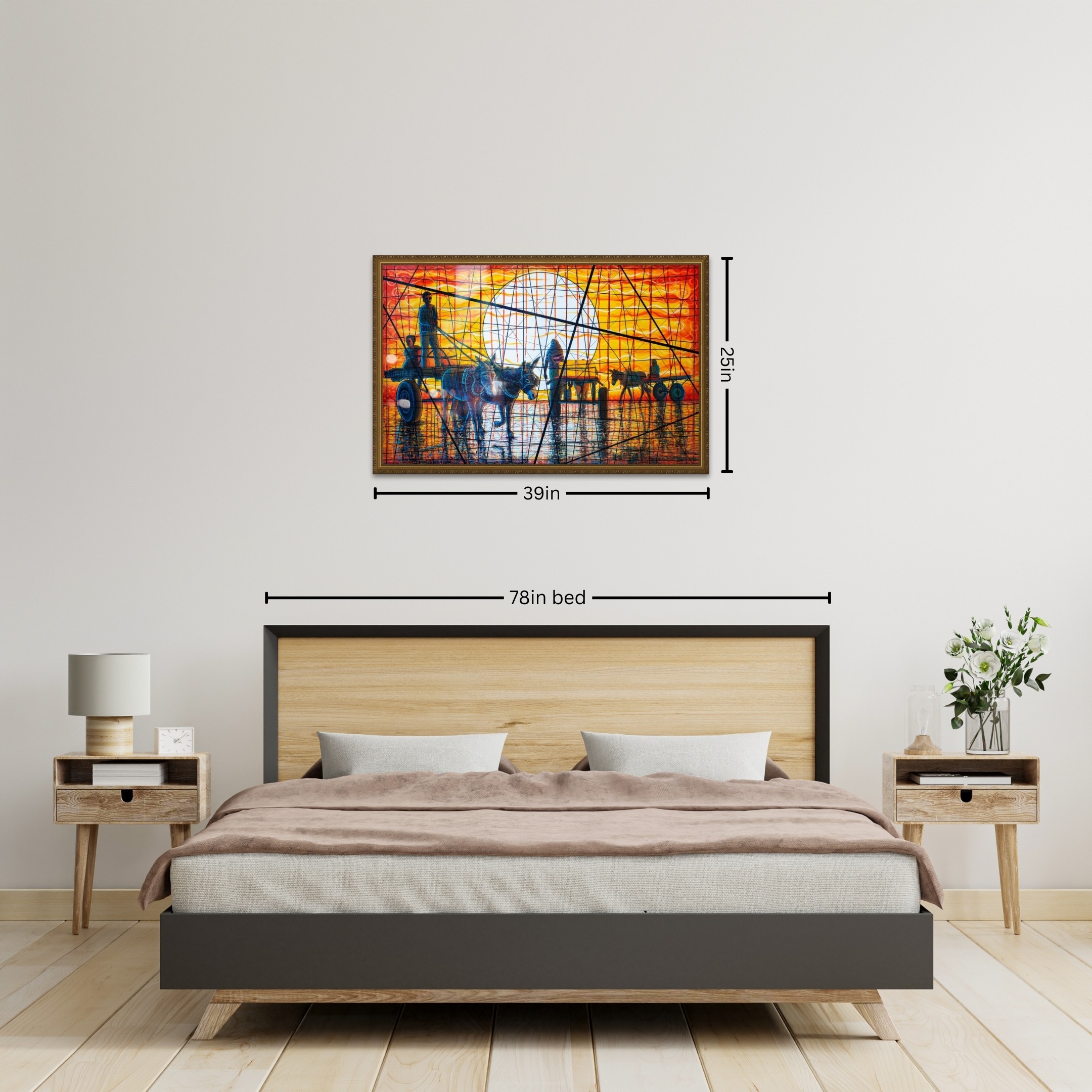
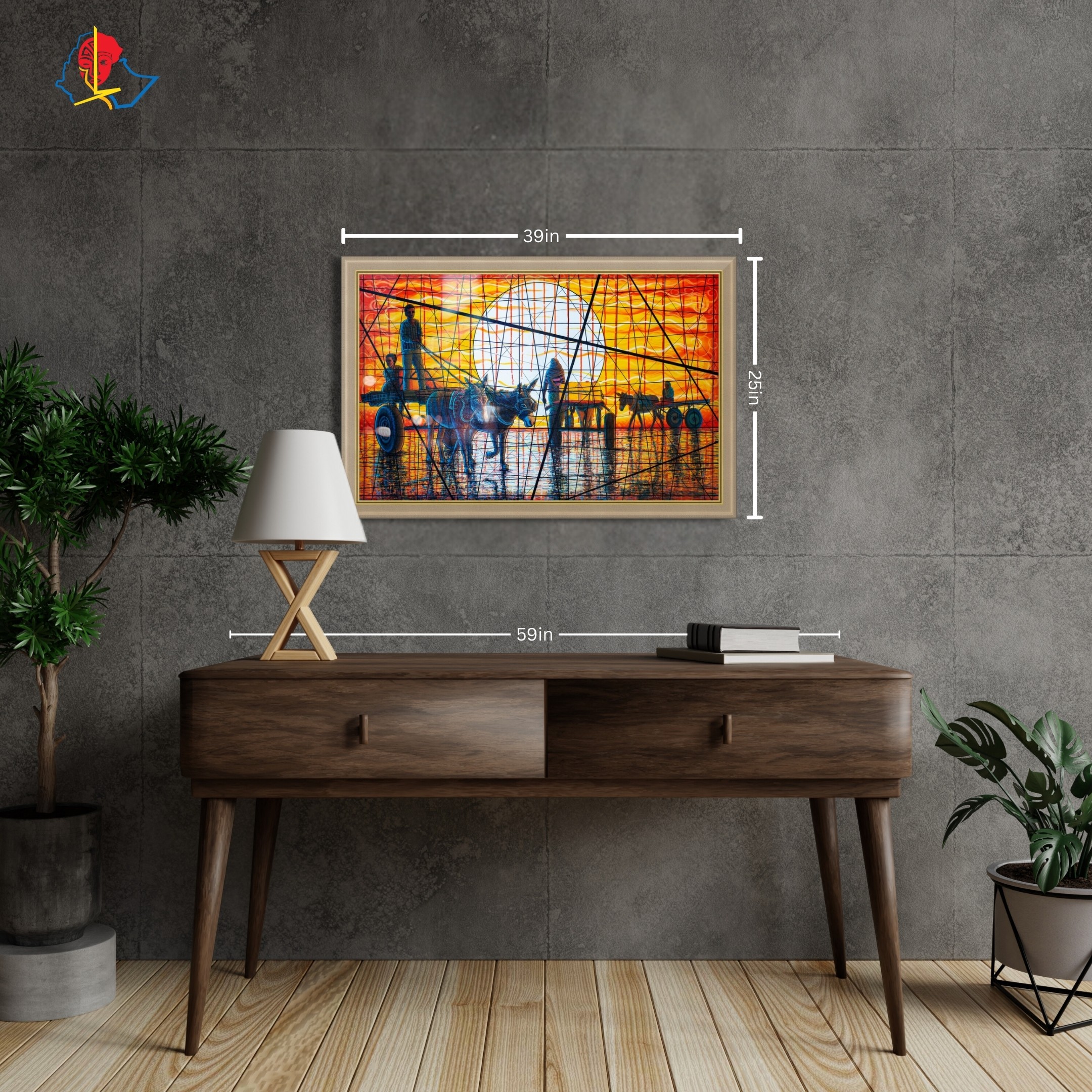
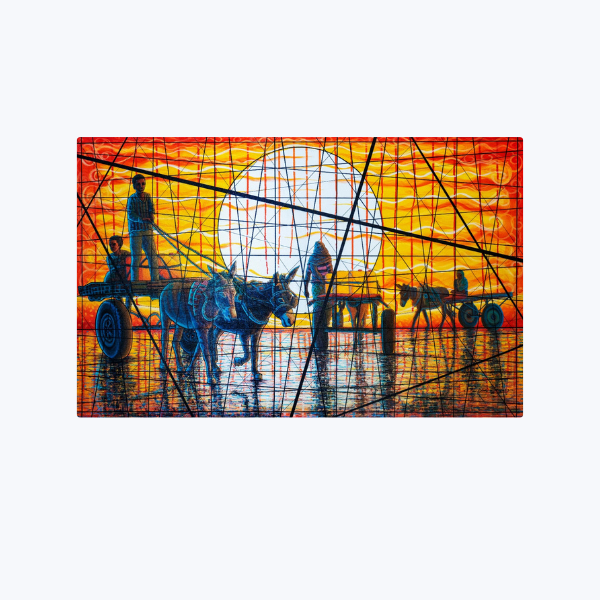
Robel Wolde’s The Journey for Water captures the daily quest for water in rural Ethiopia with poetic grace. Against a radiant golden sun, donkey-pulled carts traverse a reflective wet ground, their figures moving with a quiet dignity that transforms labor into ritual. The vibrant orange and yellow palette, contrasted by the donkeys’ blue tones, bathes the scene in warmth, suggesting a life-affirming harmony rather than hardship.
Intersecting black lines fracture the composition, symbolizing the barriers—geographic, economic, societal—that shape this journey, while also framing the interconnectedness of human effort and nature. The reflections in the water create a dreamlike duality, echoing generational endurance and the cyclical nature of life. This is not a painting of struggle but a celebration of perseverance and partnership.
Visual and Cultural Synthesis
The composition of The Journey for Water is a masterful balance of form and meaning. The central sun, a beacon of abundance, contrasts with the grid-like lines, creating a dynamic tension that mirrors the rhythm of survival. Robel’s use of color—golden hues evoking the sun, blues grounding the donkeys, and reflections adding depth—pays homage to Ethiopian traditions while
embracing modernist abstraction. The textured application of paint enhances the tactile quality, inviting viewers into the scene’s layered narrative.
A Philosophy of Harmony and Endurance
Robel’s work embodies a philosophy where art is a celebration of coexistence—between humans, nature, and tradition. The Journey for Water elevates a daily task into a universal hymn, challenging viewers to find joy in resilience. This approach positions Robel as a storyteller who places Ethiopia’s quiet strength within the global canon of human experience.
Why the World Must Take Notice
The global art world is increasingly acknowledging Africa’s creative legacy, yet Ethiopia’s unique voice—shaped by Byzantine influences and centuries of independence—remains underexplored. Robel’s fusion of narrative vitality and contemporary technique redefines African identity, urging collectors and curators to see Ethiopia as a vital source of artistic inspiration.
Limited Editions: Preserving a Cultural Narrative
Adulis Ethiopian Art releases only 100 signed prints of The Journey for Water:
- Hand-signed and numbered by Robel Wolde
- Produced with archival inks on acid-free paper
- Accompanied by a certificate of authenticity and symbolic notes These prints are more than art; they are invitations to partake in Ethiopia’s living history and support its cultural resurgence. About the Artist: A Modern Visionary Born in Addis Ababa in 1993, Robel Wolde brings 12 years of studio experience to his craft, crafting a bold, colorful style that honors everyday moments. His work, akin to Ethiopian Orthodox iconography, devotes itself to the human experience, transforming ordinary scenes into eternal narratives with warmth, dignity, and dynamic energy. Adulis Ethiopian Art: A Platform for Empowerment Adulis Ethiopian Art champions Robel’s vision, supporting local artists, limiting production, and fostering education to reshape the global perception of African art, with Ethiopia at its center. In Conversation with the Masters
The Journey for Water resonates with Jean-Michel Basquiat’s narrative depth, El Anatsui’s transformative motifs, and Kehinde Wiley’s dignified recontextualizations, yet Robel’s voice is uniquely his own, inviting a global dialogue.