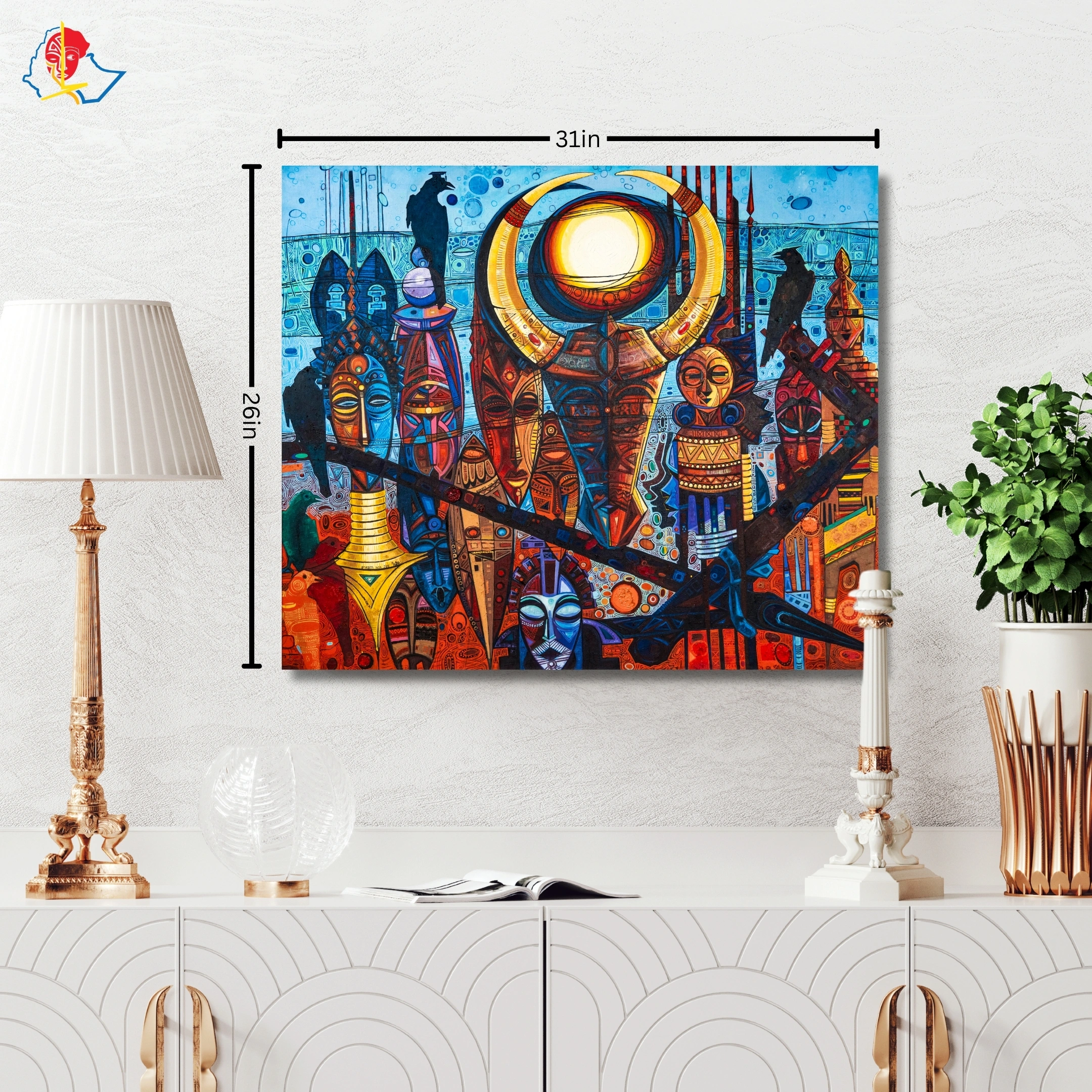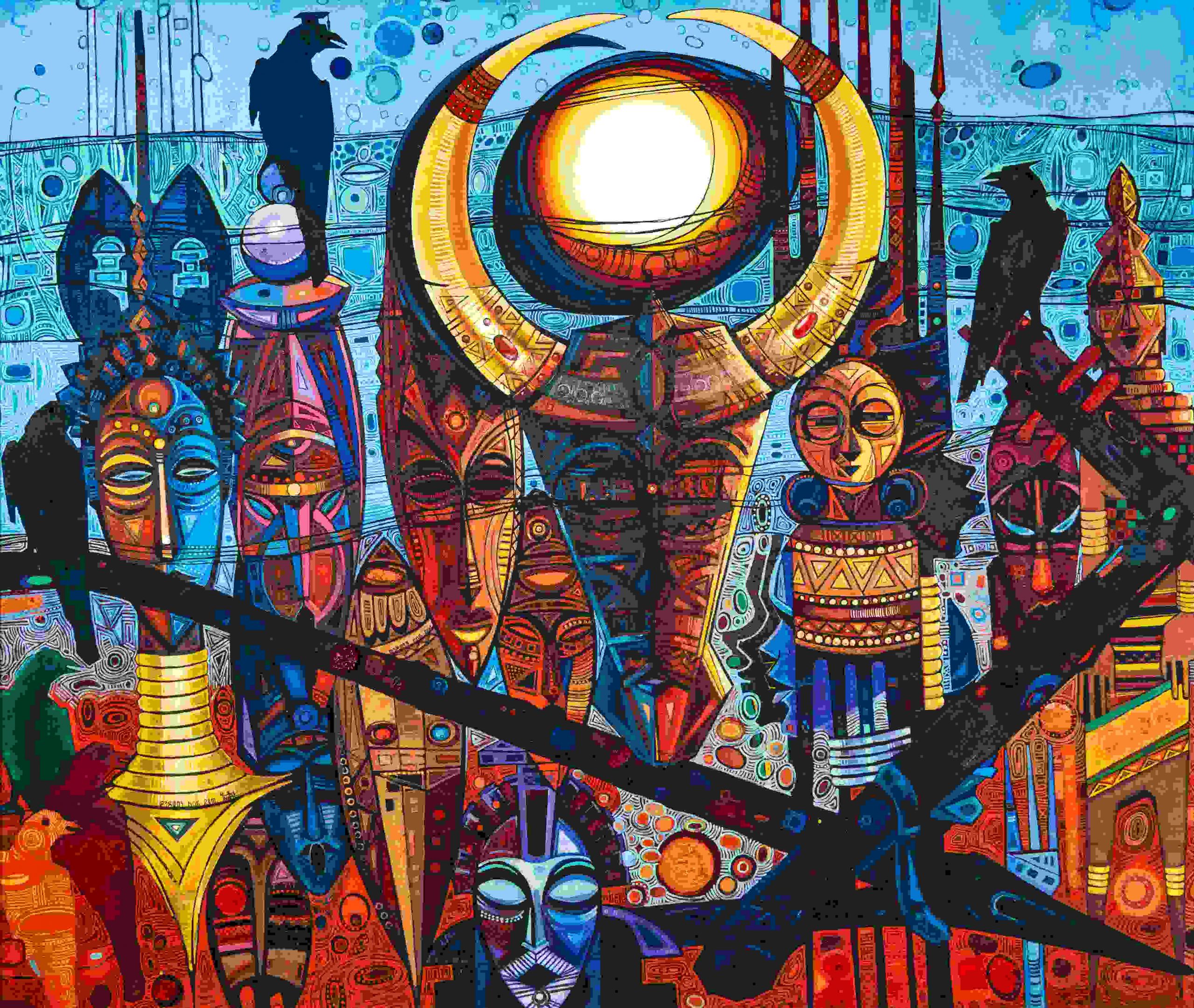
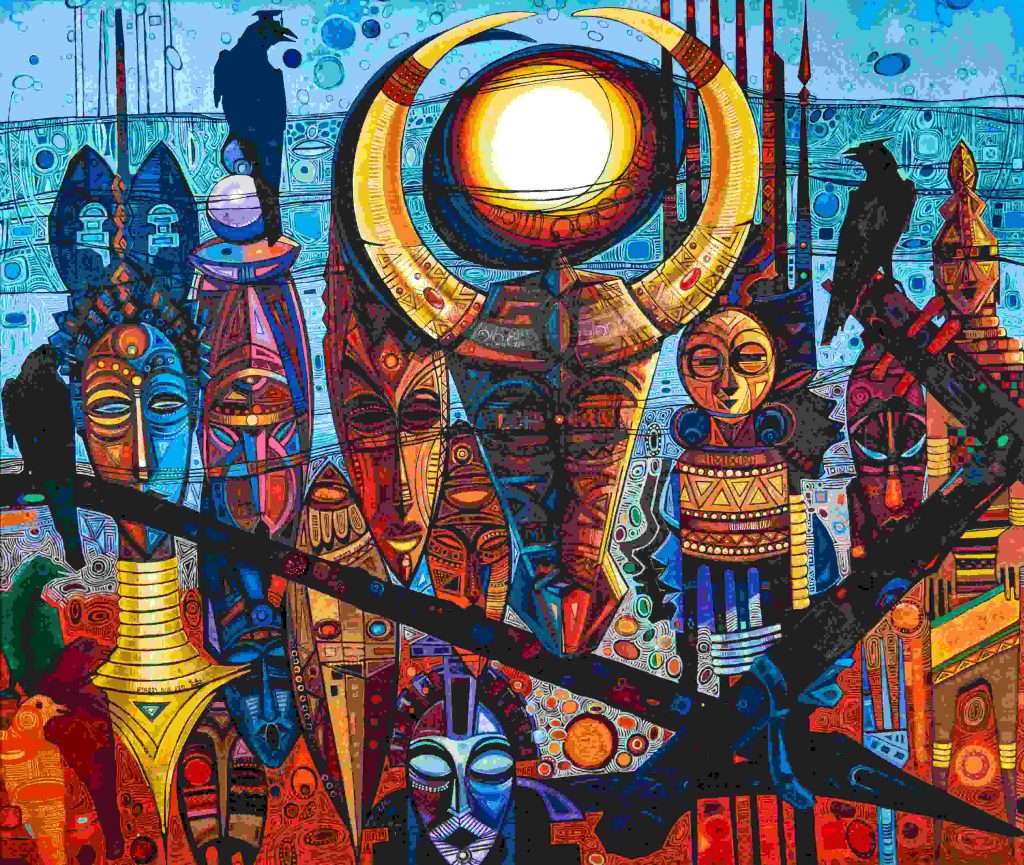
In the realm of contemporary African art, few works possess the gravity, the density of meaning, and the cultural resonance of Wendwesen Kebede Abera’s Sun Above the Ancestors. Bold yet sacred, mystic yet precise, the painting vibrates with an urgency that defies quiet contemplation. It demands to be read as much as it is seen. Every stroke, every crow, every mask-like face speaks not only of an artistic lineage—but of a cultural cosmology.
This is not a work to decorate a space. It is a piece to challenge, to invite reverence, to hold witness.
Now released in a limited edition of 100 fine art prints by Adulis Ethiopian Art, Sun Above the Ancestors arrives not merely as an artwork—but as an event in Ethiopian visual history.
The Painting: A Ritual in Oil and Geometry
Spanning a vast visual spectrum, Sun Above the Ancestors appears as a ceremonial tapestry—a council of ancestors gathered beneath a sun that pulses with divine consciousness. It is both an altar and a mirror.
The Diagonal Spear-like Lines – Slicing through the canvas, these diagonal slashes act as both compositional anchors and cultural ruptures. They might signify movement through history—interruptions, resistances, progressions. This is not mere decoration. It is architecture. A memory palace constructed through abstraction, traditional geometry, and color logic.
The Faces and Masks – These figures are neither purely human nor mythological. They are transfigured ancestors. Some recall Ethiopian highland sculpture, others seem drawn from pan-African ceremonial art. The multiplicity of style signifies Ethiopia’s unique place as both singular and pan-African—a cultural crossroads not just of the continent, but of time itself.
The Sun and Moon Motif – The twin celestial bodies suggest an alignment beyond the temporal: eternity made visible. They reflect the solar-lunar calendrical rhythm of Ethiopia, where time follows the sacred rather than the mechanical.
Birds as Memory Keepers – The black birds—ravens, crows—recur in Wendwesen’s work. They are witnesses. They carry stories. In some interpretations, they represent diasporic consciousness: always watching, always returning.